
Build a Vista People Search
The best first source depends on the fact already known. A full name can lead to the San Diego Superior Court index, recorded instruments, licenses, business filings, or unclaimed property. A Vista street address works better in an assessor, tax, GIS, permit, or deed trail. An older address may call for city directories, newspaper archives, probate records, and historic recorder indexes. Phone numbers appear most often in current staff, school, professional, and business directories.
Vista does not have one resident list. Most official records are kept by the office that created them, and the same name can appear in several systems for unrelated reasons. Search narrow fields first. Add a middle name, year, case location, business name, or document type when a common name returns too many matches. Then compare dates and places before treating two entries as the same person.
- Write down the name, address, date, or organization already known.
- Confirm whether the address lies inside Vista with city or regional GIS.
- Search the record system that best fits the known fact.
- Use the index number to request the actual file or certified copy.
- Check a second official source before relying on the match.
Vista People Records Custodians
Vista City Clerk coordinates municipal public records, including city agendas, minutes, contracts, planning material, and other files created by city departments. San Diego County Assessor/Recorder/County Clerk, known as ARCC, keeps recorded instruments, assessor data, fictitious business names, and county birth, death, and marriage certificate requests. The Registrar of Voters runs Vista voter self-service lookup and reviews qualified voter-file applications.
The office matters more than the mailing city. Deeds and county certificates do not move to Vista City Hall merely because the subject lived in Vista. Court cases belong to San Diego Superior Court, while sheriff reports and jail data belong to the San Diego County Sheriff. The detailed access rules and copy procedures appear in the Vista public records system.
San Diego County ARCC
ATTN: Real Estate Records
P.O. Box 121750
San Diego, CA 92112-1750
Vista City Clerk
200 Civic Center Drive, 2nd Floor
Vista, CA 92084
760-639-6125
Search Beyond Vista City Files
A Vista mailing address is not proof that the City of Vista holds a record. Postal names can cross legal boundaries, and a record may follow a county parcel, sheriff service area, school district, court division, or election precinct. The City of Vista GIS applications and the regional SanGIS viewer help establish whether a place is within city limits before a request goes to the City Clerk.
This countywide structure is a useful Vista records quirk. The city incorporated in 1963, long after San Diego County began keeping land and clerk records. Older Vista families therefore appear far more often in county deeds, historic newspapers, directories, court books, and state archives than in a city-only file set. For current civic records, the City Clerk also offers online browsing and staff help during its posted business hours.
Jurisdiction check. Confirm the parcel boundary before filing a Vista records request, especially when a postal address sits near an unincorporated edge.
Read Vista Recorder Search Results
The San Diego County Official Records Index covers recorded real-property documents from 1970 to the present. A name search can reveal grantors, grantees, document type, document number, and recording date. Grantor often means the person giving or transferring an interest. Grantee is the person receiving it. These labels change with the document: a trust deed may name a trustor and beneficiary, while a judgment can identify debtor and creditor.
The public web index shows indexed facts, not the recorded image. Copies may be ordered for mailing, and ARCC public kiosks provide another viewing channel. The older kiosk holdings reach deeds from 1845 through 1930, grantor and grantee indexes from 1846 through 1969, Official Records from 1931 through 1989, numeric indexes, and maps. Since December 9, 2024, APN searches have been removed from the web index but remain available on ARCC kiosks.
| Search field | Best use | Key limit |
|---|---|---|
| Grantor or grantee | Find a person named on a recorded instrument | Common names need dates or document types |
| Recording year | Narrow a known transaction period | Online coverage begins in 1970 |
| Document number | Order the exact copy | Number must match the index |
| Document type | Separate deeds, liens, notices, and maps | Indexed data is not the document image |
Note: A recorder index entry proves that a document was recorded, but its image and legal effect must be checked in the actual instrument.
Follow a Vista Address Trail
Property systems connect an address to a parcel, then to recorded names. Start with ParcelQuest or SanGIS to obtain an Assessor Parcel Number and review available property characteristics or map context. ParcelQuest allows up to 25 searches in a 30-day period before a subscription may be required. The Treasurer-Tax Collector adds tax-bill searches by parcel or bill number, mailing address, or unsecured bill number.
Keep three address terms apart. A situs address is the physical property location. A mailing address is where tax notices go, which may point to an owner, estate, trust, or manager elsewhere. A legal description identifies land through lot, tract, map, or boundary language. Once the parcel is known, move into ARCC deeds, trust deeds, liens, notices, and transfer records to follow the name trail over time.
- Parcel
- A mapped unit of land tracked by the assessor.
- APN
- The Assessor Parcel Number used across county property systems.
- Situs
- The physical address of the parcel, not necessarily the owner's mailing address.
- Index
- A searchable summary that points to the recorded file.
Check Vista Court Records Carefully
Vista cases are served by the Superior Court of California, County of San Diego, with many local matters associated with the North County Division. The San Diego Court Index accepts a party name, case number, or District Attorney case number. A name result can show the case title, number, location, type, filing date, and parties. It does not show charges or the disposition.
The index is a lead, not the official court record. Confirm the case at the clerk's office where it was filed. Criminal documents are obtained in person or by mailed copy request. Some later civil, small claims, probate, and family documents have online Register of Actions purchase options. Juvenile and sealed files remain restricted, traffic and minor offenses are excluded from the main index, and older cases may require hardbound books or microfilm.
The Court Index landing screen shows the available name and case routes. Open the official court search before reviewing the captured interface.
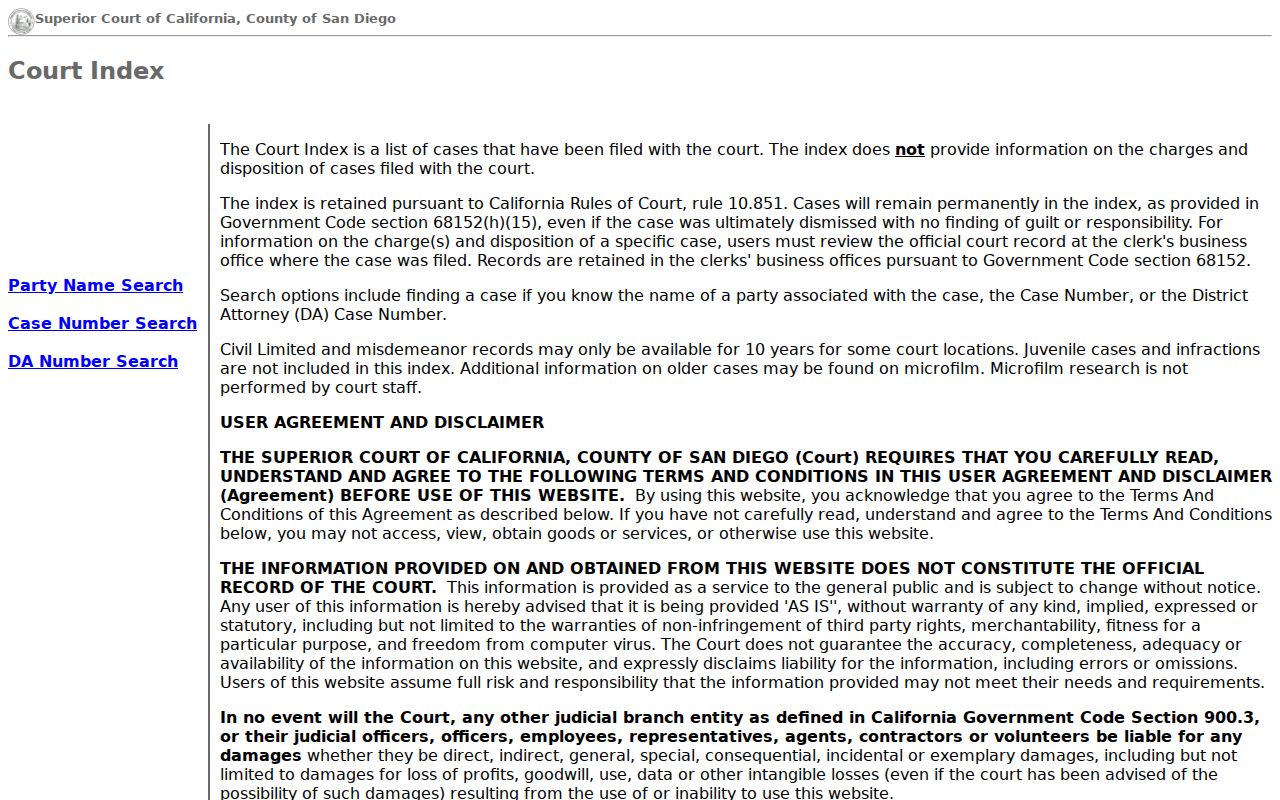
The separate search modes help prevent a case-number lookup from being confused with a broad party-name query.
| Court source | Coverage | Offline route |
|---|---|---|
| San Diego Court Index | Generally 1974 to present | Clerk office for the filed case |
| Central Division older indexes | 1880 to mid-1974 | Hardbound books and microfilm |
| Federal Southern District cases | PACER docket coverage | Federal clerk or public terminal |
Order Vista Vital Records
San Diego County ARCC issues birth and death certificates for events in the county and marriage certificates when the license was issued there. The County Office of Vital Records and Statistics is another local path for county birth certificates. California Department of Public Health-Vital Records handles the statewide collection, which is useful when the event county is uncertain or a state process is required.
Modern certificates are not open name directories. California distinguishes an authorized certified copy from an informational certified copy. Authorized copies are limited by family relationship, legal role, court order, or official duty under Health and Safety Code section 103526. Informational copies carry a notice that they are not valid to establish identity. Confidential marriage copies are limited to a party or a person with a court order, and divorce decrees belong to Superior Court rather than ARCC.
ARCC offers counter, mail, and approved online ordering channels. Mailed authorized requests require a sworn statement and notarized acknowledgment. If no record is found, the search fee is retained and ARCC issues a Letter of No Record.
Use Vista Custody Lookups Lawfully
Vista contracts for law enforcement through the San Diego County Sheriff, so custody and many incident records do not come from a city police department. The Sheriff's Who's In Jail lookup uses first and last name fields with a two-character minimum. It reports current county custody information and is normally taken offline for brief maintenance on Wednesdays at noon.
The captured search screen shows the county route used for a Vista custody check. Review the official Sheriff's lookup and its warnings before using the form.
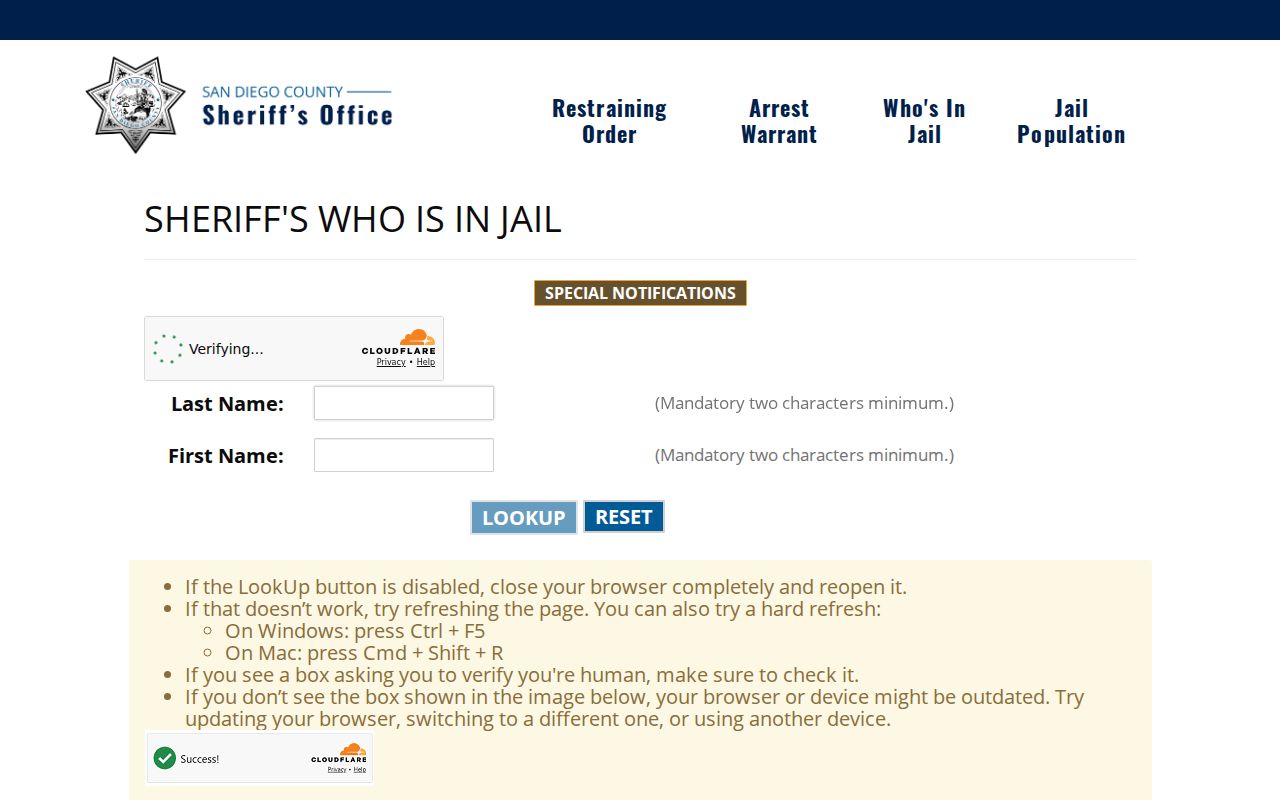
Results may include custody location, arrest, bail, release, case, and charge details, but the Sheriff says the data should not support legal action.
State prison custody uses California's CIRIS search, while federal custody from 1982 forward uses the Bureau of Prisons locator. Sheriff crime, arrest, and accident reports follow a request process through the Sheriff's Public Records Center, a station, or the service request form. Most such reports have a stated $20 fee and a 3-to-10-business-day service goal, subject to access limits.
Search Vista Safety Records
California Megan's Law provides a public registry for safety use under Penal Code section 290.46. The state says law enforcement updates it daily. Searchers must still guard against mistaken identity because a name, age, or address can describe the wrong person. Registry information is provided for public protection, not for harassment or harm.
The state registry displays its terms before the search tools. Read the California Megan's Law use limits before viewing the Vista-related capture.
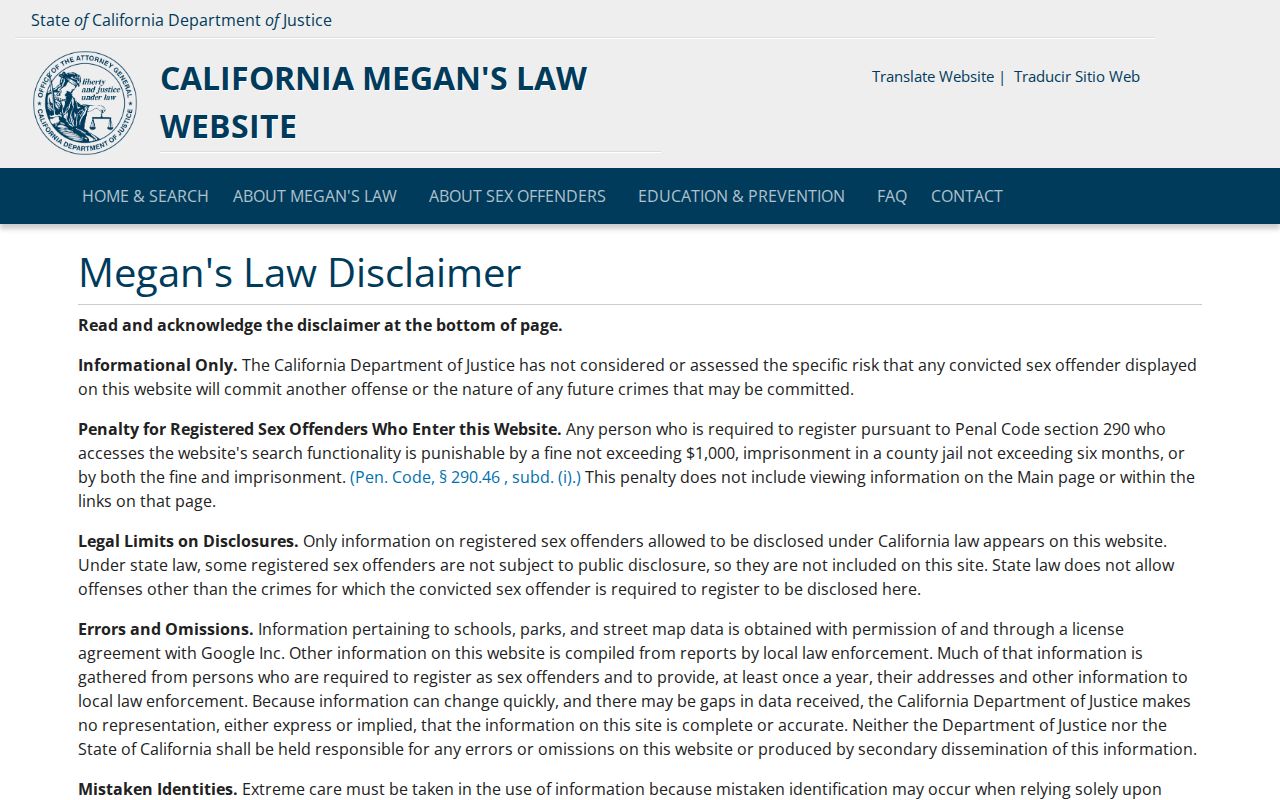
The prominent notice is part of the search process and should be treated as a core limit, not a routine banner.
Lawful use only. Public records may support personal safety and civic research, but no result may be used to stalk, harass, threaten, or harm anyone.
Find Vista Business Names
A local business trail can start with the City of Vista business-license search, which accepts business name, address, type, or account number and an optional date range. A fictitious business name then routes to San Diego County ARCC because FBN filings are county records, not a statewide registry. California Secretary of State bizfile adds corporations, limited liability companies, partnerships, and related filings.
The state business portal can connect an entity name to status, addresses, agents, and filed documents, depending on the record. Its online data is not a complete or certified copy. Open the official California business entity search before using the interface shown below.
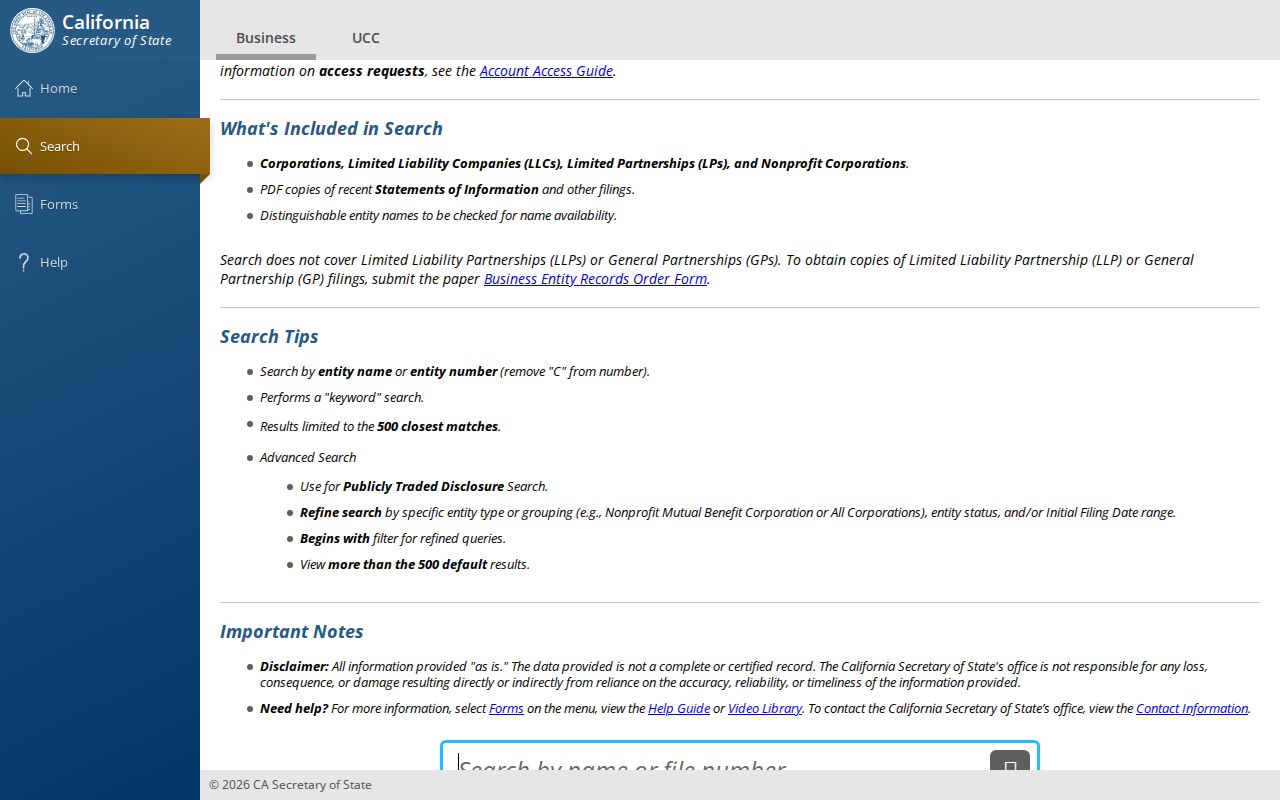
Use the returned entity number or filing detail to distinguish similarly named Vista companies, then request certified records when proof is needed.
UCC filings add debtor and secured-party abstracts, while the Vista Chamber member directory can identify current member firms and contact persons. Chamber membership is voluntary, so a missing listing does not mean a business lacks a city license or state filing.
Verify Vista Professional Licenses
California Department of Consumer Affairs License Search is a strong name-based source for regulated trades and professions. Its advanced form accepts first name, last name, license number, business name, registry number, and a board or bureau. Results can show whether a license is current, expired, suspended, revoked, or disciplined. That status should be checked on the specific board record before drawing a conclusion.
The search covers many boards, including accountancy, architects, automotive repair, barbering and cosmetology, cemetery and funeral, medical, pharmacy, real estate-related services, security and investigative services, and contractors within the wider licensing system. Open the DCA advanced license search to see the current selectors.
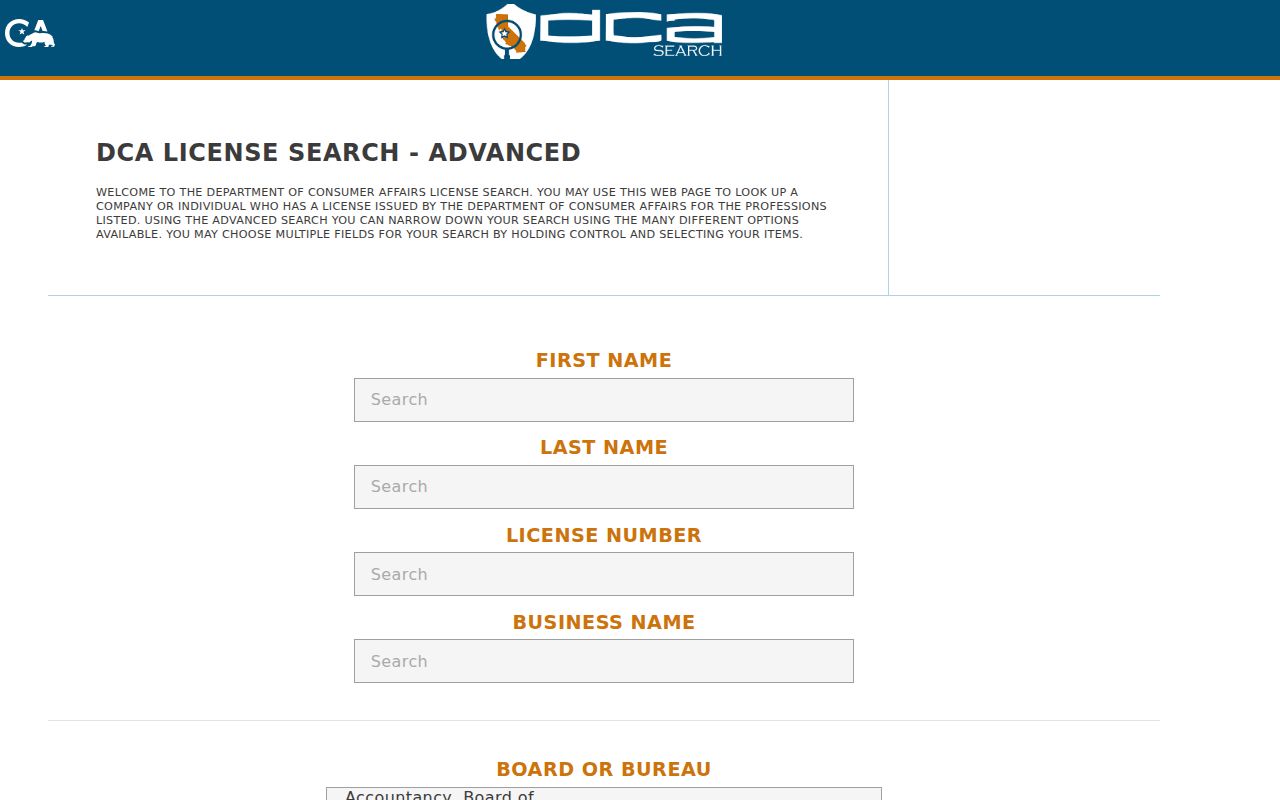
The board selector matters because two people with the same name may hold records in different regulated fields.
Check Vista Unclaimed Property
California's unclaimed property database is a useful way to locate a name tied to a past address or business. Property can include dormant accounts or funds transferred to the State Controller after the holder lost contact with the owner. The search and claim process are free, and the Controller says there is no deadline to claim property.
The official page also warns about firms that pretend to represent the government or demand needless fees. Use the State Controller's unclaimed property search before reviewing the captured search entrance.
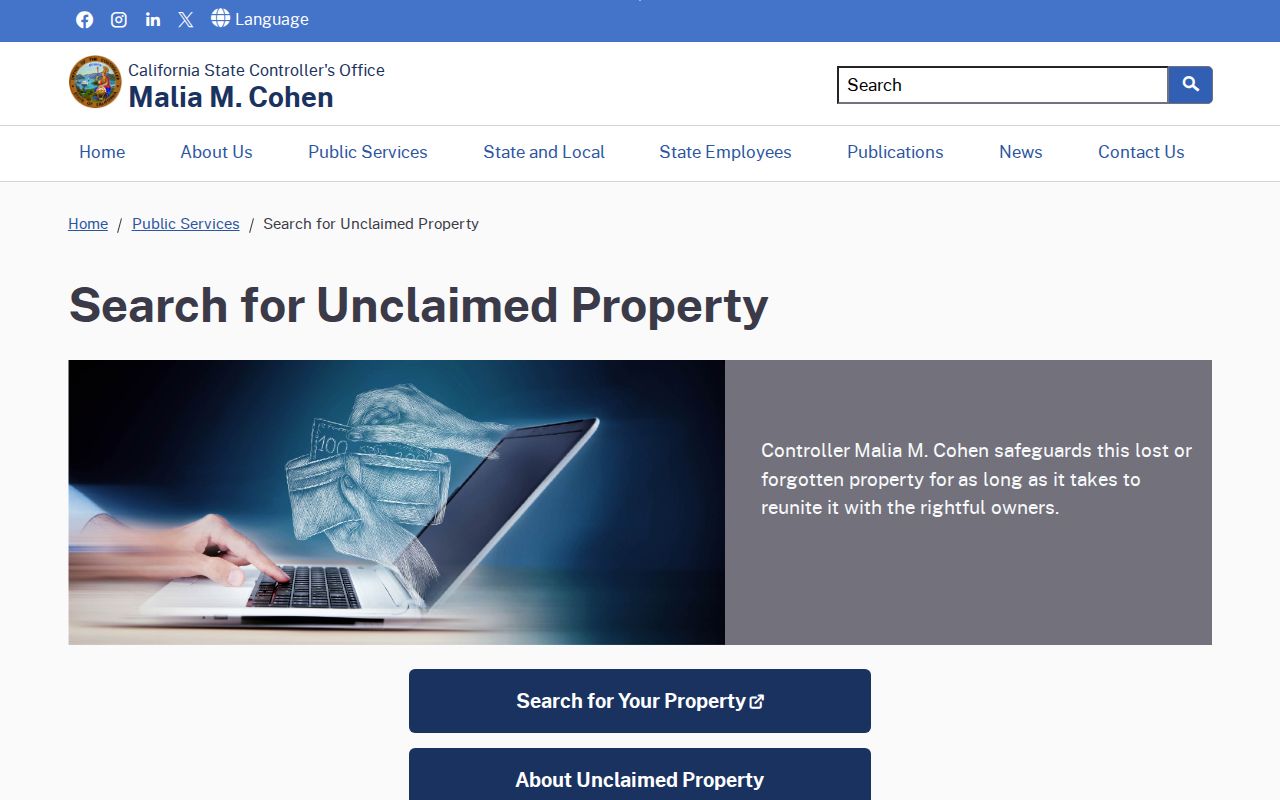
A matching Vista address or business can help separate names, but only the state's claim process can establish whether the property belongs to the claimant.
Trace Old Vista People Records
Old Vista address work rarely ends with one portal. The Vista Historical Society's Vista Press archive exposes years from 1926 through 1973 and can reveal obituaries, school news, clubs, businesses, and social notices. San Diego Public Library adds San Diego Union obituary microfilm back to 1865, more than 10,000 genealogy books, periodicals, and database access. Countywide city directories link names with addresses and occupations.
ARCC County Archives provides the land-record backbone, while the California State Archives catalog can lead to San Diego County probate files, wills, naturalizations, deeds, homesteads, and selected vital records. Naturalization files held through the National Archives may contain a prior nationality, residence, occupation, arrival details, and witnesses. Early San Diego County deeds can even concern land now in Imperial, Riverside, or San Bernardino Counties because the original county boundaries were larger.
A practical flow is: old address to directory entry, directory name to obituary, obituary to relatives, and relatives to probate or deed records. The Vista local directories page separates current staff and business sources from these historic collections.
Protect Vista Search Privacy
Official access has real privacy limits. Juvenile and sealed court files are closed. Voter files omit driver license numbers, state ID numbers, partial Social Security numbers, unique identifiers, and signatures. Confidential voter records are excluded. Vital certificates separate authorized and informational copies, while Safe at Home gives eligible participants a substitute mailing address so covered agencies can avoid disclosing a protected residence.
Commercial databases compile data from many sources and may be stale, costly, or wrong. Official sources are slower but make the custodian, update cycle, and correction path clearer. Use a commercial category result only as an unverified lead, never as proof. California residents can also use the California Privacy Protection Agency's DROP system. One deletion request to active data brokers became available January 1, 2026, and brokers must begin processing covered requests on August 1, 2026.
| Source type | Strength | Main caution |
|---|---|---|
| Official index | Direct link to a custodian | May omit images or closed fields |
| Certified copy | Office-issued record | Eligibility and fees may apply |
| Commercial compilation | Fast cross-source lead | Errors, stale data, and unclear sourcing |
Note: Verify every Vista identity match with the record custodian, especially when names are common or an address may be outdated.