
Search Vista Voter Registration
The San Diego County Registrar of Voters Voter Information Lookup is the direct online channel for a Vista voter checking personal election information. Enter the street parts as separate values. A prefix such as North belongs in the pre-direction field, while a suffix goes in the post-direction field. The required marks shown by the tool identify house number, street name, and ZIP code. Birth date and party preference also appear, but the static form text does not clearly mark them as required. Supply accurate values rather than guessing because the service is built to match an individual voter to a registration address.
| Lookup field | Input style | Required | How to enter it |
|---|---|---|---|
| Party preference | Select menu | Unclear | Choose a preference from the available list. |
| House number | Number or text | Yes | Use only the street number. |
| Birth date | Date or text | Unclear | Used as personal match data. |
| Pre-direction | Select or text | No | Add N, S, E, or W only when part of the address. |
| Street name | Text | Yes | Leave out the house number and street type. |
| Street type | Select or text | No | Choose the matching type, such as Ave, St, or Rd. |
| Post-direction | Select or text | No | Use only when it follows the street name. |
| ZIP code | Text | Yes | Enter the five-digit ZIP. |
Check the official interface before entering the address. The county voter lookup shown here displays the address and date fields used for the match.
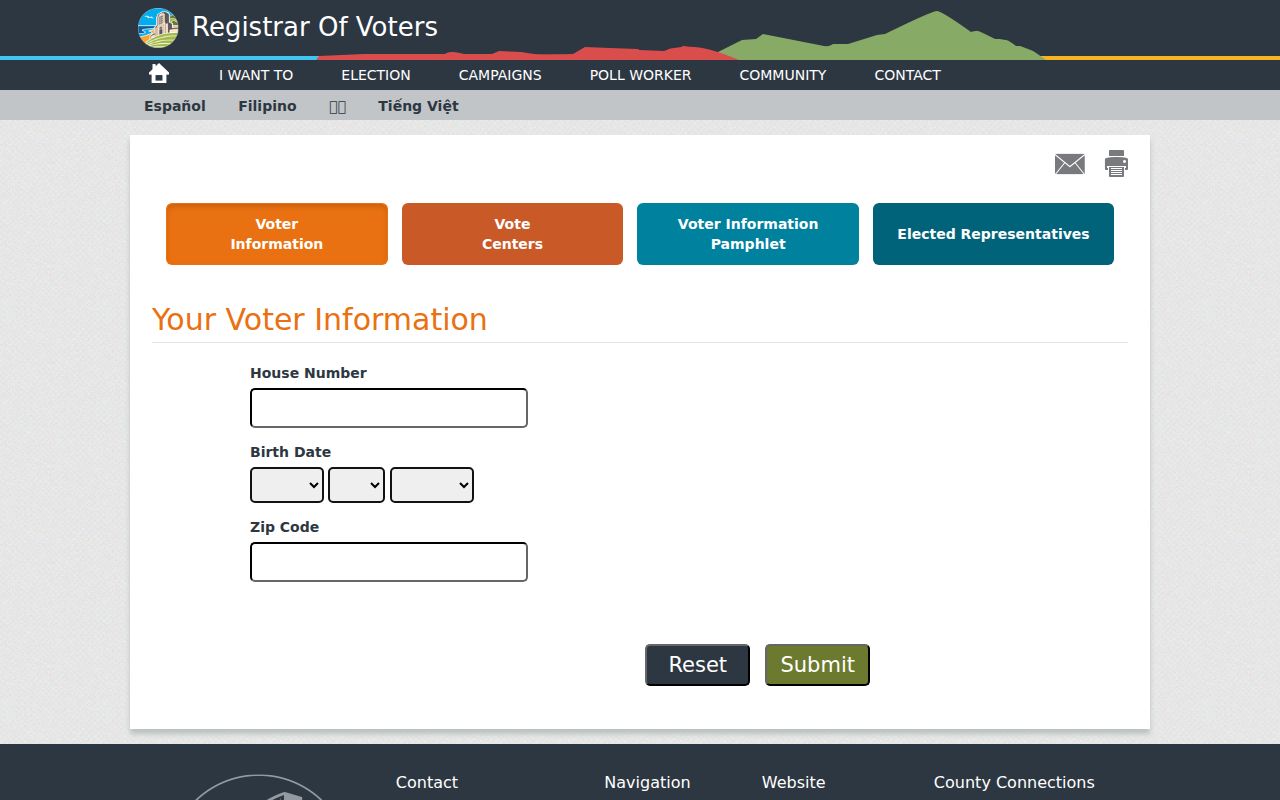
The screen reinforces why each address element must go in its own box. It also links voters to vote-center, voter pamphlet, and elected-representative information after they confirm the correct registration.
Vista Voter Lookup Limits
The county tool is not a reverse directory of everyone registered near a Vista address. It is a self-service check designed around facts the voter already knows. A person cannot enter a stranger’s name and receive a neighborhood voter list. That design separates a routine registration check from access to the larger voter file, which requires an application, identity proof, an approved purpose, and safeguards for the data.
If the online values do not produce a match, use the Registrar of Voters as the fallback. The San Diego County ROV website is the official office channel, and the voter lookup footer gives the county information number as 858-694-3900. An address can include a direction or street type that is easy to put in the wrong box. Confirm each part before treating a missing result as a cancelled record.
Two paths, two purposes. Self-lookup uses address and personal match fields; access to a broader Vista voter roll requires a qualified application and strict use limits.
Vista Voter Records Inventory
An approved California voter file can contain more than the self-lookup returns. The voter data file includes the registrant’s name, date of birth, registration date, residence and mailing addresses, precinct, contact information, and political party preference. A request may also seek available voting history and precinct-to-district data. These records can help with approved election, scholarly, journalistic, political, or governmental work, but they do not reveal how anyone marked a ballot.
| Registrant identity | Name and date of birth appear in the approved file. |
|---|---|
| Registration details | Registration date, status, and party preference may be included. |
| Address data | Residential and mailing addresses may appear unless protected by law. |
| Election geography | Precinct and requested precinct-to-district data connect a voter to districts. |
| Contact fields | Contact information may be supplied in the permitted data set. |
| Voting history | Participation history may show that a voter took part, never the voter’s choices. |
| Roll status | Active voters are automatic; inactive records must be requested. |
The state delivers approved information in three tab-delimited plain-text sets: the Voter Registration Data File, Voting History File, and Precinct-to-District File. “Tab-delimited” means that tabs divide the fields in each line so database or spreadsheet software can place them into columns. A county file covers San Diego County registrants, including Vista voters, while a statewide request covers the approved California scope.
Note: Voting history records participation only and never discloses the candidate, measure, or position selected on a secret ballot.
Confidential Vista Voter Records
California does not treat the voter file as unrestricted public data. Elections Code section 2194(b) excludes a driver’s license number, California identification card number, the last four Social Security number digits, the voter’s unique identifier, the signature, and any digitized signature image. Pre-registration records for people ages 16 and 17 are also excluded because they are minors and do not become registered voters until age 18.
Protected voter registrations receive another layer of privacy. Records made confidential under Elections Code sections 2166, 2166.5, 2166.7, and 2166.8 are not supplied to an authorized purchaser of voter data. The California Safe at Home program supports eligible participants with a substitute mailing address as part of a safety plan. State and local offices can then respond to public-record requests without exposing the protected home address.
Confidential under California law. Identification numbers, partial Social Security data, voter identifiers, signatures, protected-voter records, and minor pre-registration records are withheld from Vista voter files.
Request Vista Voter Registration Files
Qualified applicants may seek a statewide file from the Secretary of State or a county file from the San Diego County Registrar of Voters. The California voter file request page identifies election, scholarly, journalistic, political, and governmental purposes as possible approved uses. The decision rests on the application and stated purpose. A request for San Diego County data keeps the scope local and includes Vista voter records within the county roll.
- Complete the state or San Diego County voter data application. Give applicant contact details, qualifications, purpose, desired geography, and the requested data options.
- Explain how the file will be used, stored, and kept secure. Include a clear copy of a current driver’s license or state ID, then sign the agreement with an original wet signature.
- Send the county application in person, by mail, delivery, or courier to San Diego County Registrar of Voters, 5600 Overland Avenue, San Diego, CA 92123. Email and fax submissions are not accepted.
- Pay the applicable fee and allow 7 to 14 business days for review. The office may deny or return an incomplete or impermissible request with an explanation.
The form also asks whether inactive records, voting history, and precinct-to-district data should be included. San Diego County adds delivery choices for email or electronic transfer, mail, and in-person receipt. When a requester seeks up to ten specific voters, the form asks for each person’s full name, birth date, county of residence, and residence address.
Vista Voter File Costs
Fees depend on the keeper and product. The state guidelines list $15 per thousand records up to $100 for a broad file. A specific voter record costs $30 per record, up to $100, and an application may list no more than ten specific records. The San Diego County application instead lists a one-time electronic FTP copy of county registered voters at $75. FTP is a method used to transfer the electronic file.
| Requested product | Keeper | Published charge | Delivery or scope |
|---|---|---|---|
| Registration information file | California SOS | $15 per thousand, up to $100 | Approved statewide scope |
| Specific voter records | California SOS | $30 each, up to $100 | Maximum ten per application |
| County voter file | San Diego ROV | $75 | One-time electronic copy by FTP |
| VBM activity report, option 1 | San Diego ROV | $285 | Daily or weekly during the current election |
| Specialized VBM report, option 2 | San Diego ROV | $216 | Daily or weekly during the current election |
| County specific-record search | San Diego ROV | $98 per hour, prorated | Estimate provided before the search |
VBM means vote by mail. Printed lists can add copy costs. For an application question, the state PDF routes users to the VoteCal Help Desk at 888-868-3225 or votecalhelp@sos.ca.gov; the state web page also gives 916-654-1141. Check the current form before paying because the chosen file, delivery method, and jurisdiction control the final charge.
Vista Voter Roll Maintenance
Active voters are included automatically in a requested file. Inactive voters appear only if the applicant asks for them. San Diego County reports that the Registrar updates voter records to keep the roll accurate, including removing people who moved, died, or are no longer eligible. This maintenance explains why an old address or prior registration may not appear as an active Vista record.
A missing online match does not by itself establish why a record changed. First confirm the house number, street name, street type, directions, ZIP code, and personal match data. Then contact the Registrar rather than relying on an old list. VoteCal publishes statewide Report of Registration and Statement of Vote materials, while current local totals may be available through California voter statistics or the county data portal.
Use Vista Voter Records Lawfully
An approval does not turn a voter file into open data. The signed agreement bars an unapproved purpose, unauthorized sharing or transfer, commercial advertising or marketing, harassment of a voter or household, and leaving the data unsecured or publicly exposed. It also limits certain text-message uses when no opt-out is provided. Applicants must explain their security plan and comply with the purpose accepted by the elections official.
California Elections Code section 18109 makes knowing misuse a misdemeanor. The rule covers using registration information for a purpose not permitted by law and acquiring or using it without complying with section 2188. Secure the file, limit access to approved users, and do not republish addresses. General questions about ordinary government records belong with the separate Vista public records access process, but voter data remains governed by its own election statutes and application agreement.
Note: A qualified request grants limited access for the approved work, not permission to build a public directory or contact voters for sales.
Historical Vista Voter Registers
Modern restricted files are only one layer of the record trail. California’s 1866 Registry Act briefly placed responsibility on the County Clerk to record a list of every eligible voter in San Diego County. Vista did not incorporate until 1963, so an early resident’s election history is more likely to sit in county or state archival holdings than in a city voter system.
Search the California State Archives county and city record groups and ask the San Diego County Archives about older registers and clerk holdings. Access is archival rather than a current name lookup. Dates, custody, and surviving volumes can vary, so describe the person, likely residence, and time span when contacting staff. Historical poll books or registration lists may place a name in a county at a point in time, but they should be read beside deeds, directories, probate files, or newspapers when identity is uncertain.
The split is useful: present-day Vista voter status is private and purpose-limited, while an old register may serve family history or local research. The keeper, time period, and access rule determine which path is correct.