
Vista Records by Custodian
Public access depends on the record, not just the name or address being researched. The City Clerk keeps Vista government documents. San Diego County offices control most land, tax, court, vital, voter, and law-enforcement material tied to the city. State portals fill in business, license, prison, and registry records. The table starts with the keeper because a request sent to the wrong office can delay even a well-described search.
| Record Set | Keeper | Web Access | Coverage | Other Channels |
|---|---|---|---|---|
| City agendas, reports, permits | Vista City Clerk or department | Laserfiche browse portal | Portal years not confirmed | Clerk help, request form, counter |
| Deeds, liens, official records | San Diego County ARCC | Index only | 1970 to present online | Kiosk, mail, copy order |
| Property and parcel data | County Assessor | ParcelQuest and GIS | Current data | Assessor and ARCC copies |
| Court cases | San Diego Superior Court | Court Index and some ROA access | Generally 1974 to present | Clerk, mail, microfilm |
| Birth, death, marriage | ARCC, county OVRS, CDPH | No broad public index | County or statewide by event | Online order, mail, counter |
| Custody and incident records | San Diego Sheriff or CDCR | Custody lookups | Current custody | Request center, station, form |
Some records are open only in part. Juvenile and sealed cases, confidential marriages, protected voter details, adoption files, and Safe at Home residence addresses have firm limits. A web index may also omit the document image. For general agency material, the Vista City Clerk request channel or the correct county custodian is the fallback.
Vista Recorder Index Access
The San Diego County Assessor/Recorder/County Clerk, known as ARCC, keeps recorded deeds, liens, maps, notices, and other instruments affecting Vista property. Its Official Records Index reaches from 1970 to the present. Online results provide indexed facts, not a view of the document. A grantor is the person transferring an interest; a grantee receives it. Those party roles change with the instrument, so a lien may instead index an owner and claimant.
| Search Detail | Use | Format or Limit |
|---|---|---|
| Grantor or grantee name | Find an indexed party | Core name path confirmed by ARCC |
| Recording date or year | Narrow the time span | Year is required for a mail copy request |
| Document number | Identify one instrument | Best key for a precise copy order |
| Document type | Separate deeds, liens, notices, and maps | Required with a mail copy request |
| Book and page | Trace maps or older references | Exact web label was not verified |
The ARCC recording and copy page explains the online limit, copy methods, and current fees.
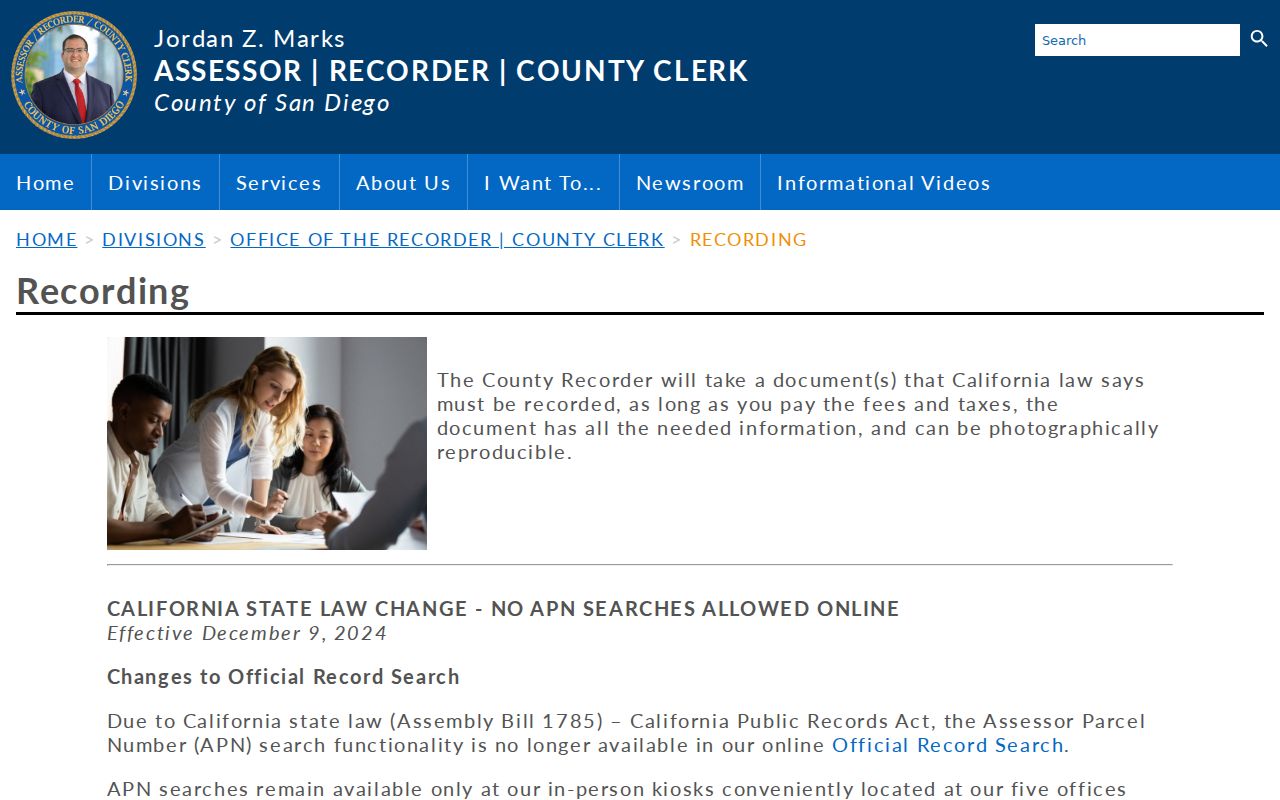
The captured page is useful after an index hit because it shows how to turn document details into a mailed or certified copy rather than assuming the web result is the instrument itself.
ARCC removed assessor parcel number searches from the public web index on December 9, 2024. APN searches still work at in-person kiosks. A researcher holding only a parcel number should use ParcelQuest or GIS first, then take the name, document number, or APN to the correct ARCC channel.
Vista Records Beyond the Web
The online start date does not mark the start of county records. ARCC public kiosks reach deeds from 1845 through 1930, grantor and grantee indexes from 1846 through 1969, a numeric index from 1872 through 1973, Official Records from 1931 through 1989, and recorded maps. County Archives preserves permanent paper and print holdings. No appointment is required, though emailing the Archives before a visit can help staff prepare older material.
- Index
- A list of names and filing facts that points to a record.
- Image
- The scanned or photographed document, which may contain facts not shown in the index.
- Certified copy
- A copy authenticated by the custodian for official use.
- Custodian
- The office responsible for keeping and producing the record.
- Exemption
- A law-based reason to withhold all or part of an otherwise requested record.
Vista incorporated in 1963, long after county land and court systems began. That is why older Vista names often appear in county indexes rather than city files. Copies still route through Recorder/County Clerk even when an archivist or kiosk supplies the reference. Archives staff can be reached at 619-237-0502, and advance questions may be sent to archives@sdcounty.ca.gov.
Note: Counter and archive access is not a lesser source; it can reveal older record groups that the public web index cannot search.
Vista Court Records and Exceptions
The San Diego Superior Court Index searches Civil, Criminal, Domestic, Mental Health, and Probate case categories. A party-name search can use case type, court location, party role, beginning and ending filing year, last or business name, first name, and date of birth. North County is a useful location choice for many Vista matters, but case type can route a file elsewhere in the county.
The index returns a case title, number, location, type, filing date, and named parties. It does not show charges or dispositions, meaning the final outcome. A case may remain indexed even after dismissal. The official record must be reviewed or requested from the clerk’s office where the case was filed.
The court party-name form shows how location and year filters narrow common names.
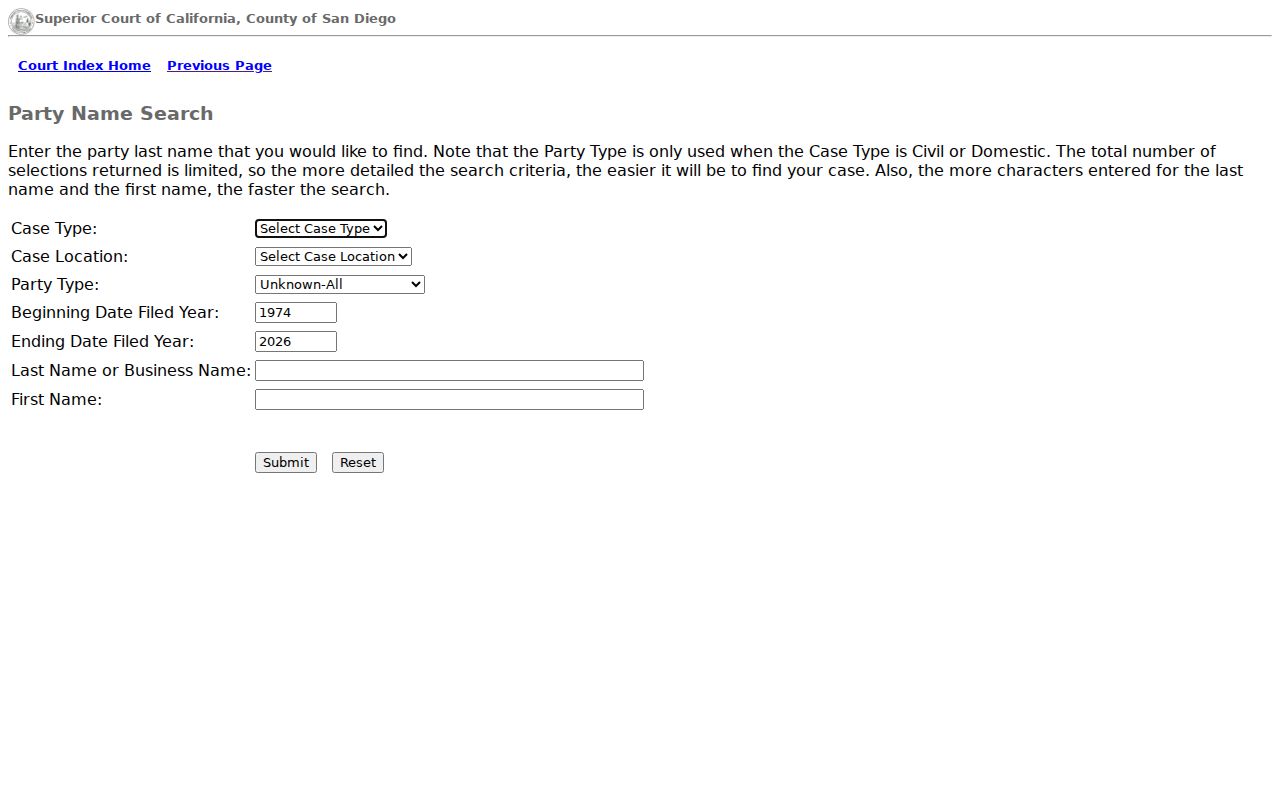
The form also shows why a broad name hit is only a starting point. Compare the filing place and date, then use the case number to request the actual file.
Juvenile cases, traffic and minor offenses, and cases before 1974 do not appear in this index. Older indexes from 1880 to mid-1974 are held by Central Division Older Records, with early years in hardbound books and later years in computer-generated indexes. Microfilm can be viewed at court locations, but staff do not perform the research. Criminal documents generally require an in-person or mailed request.
Vista Vital Records Copy Rules
ARCC issues San Diego County birth and death certificates and marriage certificates when the license was issued in the county. The County Office of Vital Records and Statistics is a second local birth-certificate route. California Department of Public Health Vital Records serves statewide needs. There is no broad official public index for modern local certificates, so access begins with a copy application, not a name search.
California separates authorized certified copies from informational certified copies. Health and Safety Code section 103526 limits authorized birth and death copies to the registrant, specified relatives, legal representatives, officials, or a person entitled by court order. Others may receive an informational copy marked as invalid for establishing identity. Confidential marriage copies go only to a registrant or a person with a court order. Divorce decrees belong to Superior Court, not ARCC.
ARCC posts fees of $34 for birth, $26 for death, and $19 for marriage certificates. In-person, online, and mail ordering are documented. A mailed authorized copy needs a sworn statement and notarized acknowledgment. ARCC advises waiting three weeks after a birth or death and ten business days after a marriage license is returned. If no record is found, the office issues a Letter of No Record and keeps the search fee.
Copy eligibility matters. An informational certificate and an authorized certified copy serve different purposes. Confirm the relationship, identification, sworn-statement, and notary rules before paying.
Vista Property Records and GIS
Property access splits among the Assessor, ARCC, the Treasurer-Tax Collector, and map systems. ParcelQuest through ARCC supplies parcel numbers, property characteristics, and assessor maps. The county allows up to 25 free searches within 30 days before a subscription may be needed. Reports and recorded documents may carry fees, and certified copies come only from ARCC.
The SanGIS parcel viewer and Vista GIS application help confirm parcel geography and jurisdiction. This resolves a local myth: a Vista postal address does not prove that Vista city government holds the sought record. A site may fall under a county or nearby jurisdiction. GIS provides that boundary check but is not proof of title.
The physical property location is the situs address. The mailing address is where the owner receives notices and may differ. The Treasurer-Tax Collector accepts searches by parcel or bill number, mailing address, or unsecured bill number. Once the parcel is clear, ARCC deeds, trust deeds, liens, notices, and transfer records supply the recorded chain.
Note: Check both city and regional GIS boundaries before deciding whether a Vista address belongs in a city or county request.
Vista Records Offices and Portals
Three offices cover distinct parts of the local system. The City Clerk coordinates municipal requests and search help. ARCC keeps county recorded instruments, property records, archives, fictitious business names, and county vital-copy files. The San Diego Sheriff handles Vista law enforcement, custody, and report requests because Vista does not operate a municipal police department.
San Diego County ARCC
ATTN: Real Estate Records
P.O. Box 121750
San Diego, CA 92112-1750
619-237-0502
Vista Sheriff Station
325 South Melrose Drive, Suite 210
Vista, CA 92081
760-940-4551
City Clerk search help is offered during regular business hours: Monday through Thursday, 7:30 a.m. to 5:30 p.m., and alternate Fridays, 7:30 a.m. to 4:30 p.m. Court files remain with the Superior Court clerk at the location shown in the case index.
The Vista Laserfiche records portal provides the municipal browse channel.
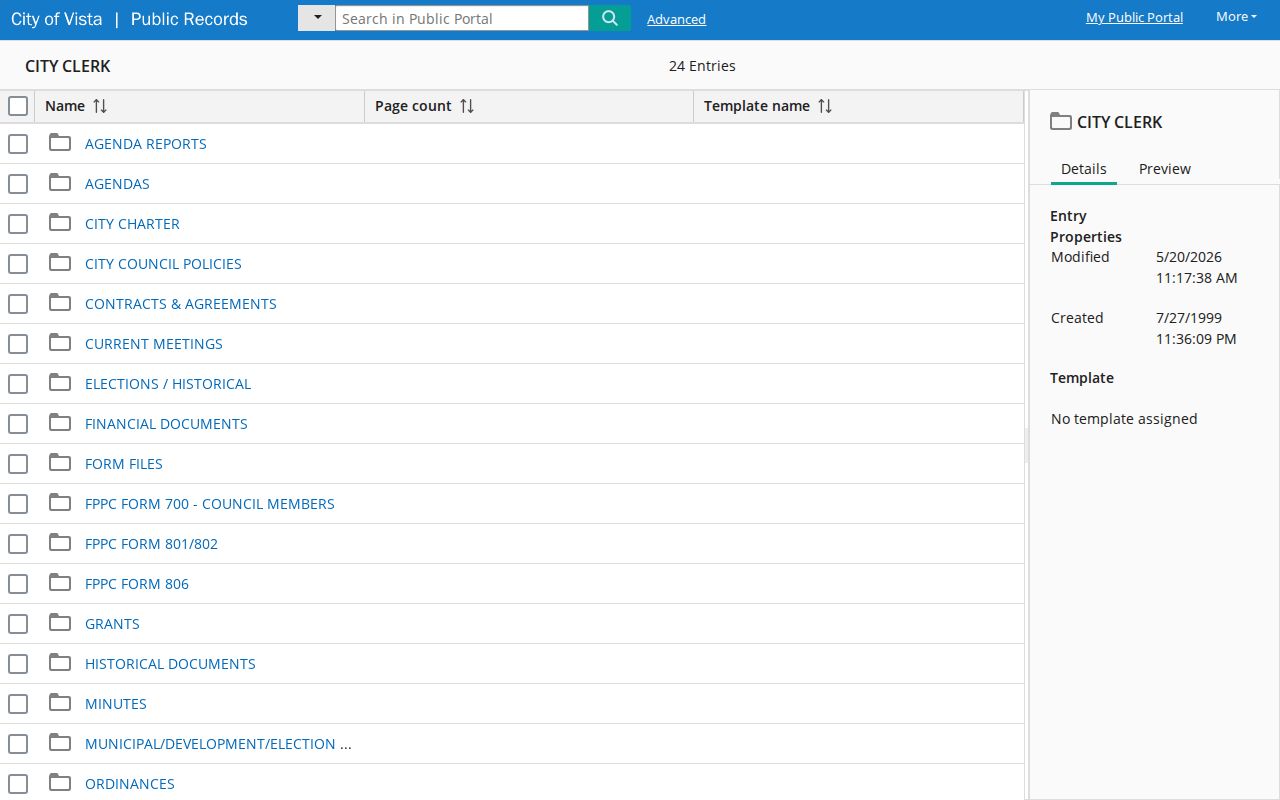
The portal is best for city-created files such as agendas, reports, and municipal documents. County deeds, court cases, and vital certificates must still be sought from their own custodians.
Vista Sheriff Records Route
Vista’s law-enforcement channel is a county system. The Sheriff’s Who’s In Jail lookup requires at least two characters in both the last-name and first-name fields. It reports current county custody information and is usually offline for brief maintenance on Wednesdays at noon. The Sheriff warns against relying on the lookup for legal action.
Crime, arrest, and accident reports may be requested through the Sheriff request center, a station or substation, or a Service Request Form. Most such reports are retained for ten years, while certain serious, missing-person, and child-related matters are kept longer. The posted report fee is $20, and the Sheriff states a goal of three to ten business days. Privacy and investigatory exemptions can limit release.
State prison records use CDCR CIRIS, which can show a current incarcerated person’s name, CDCR number, age, location, commitment county, admission date, and parole-hearing information. California’s state sex-offender registry is updated daily for public-safety use. A name, age, or address alone can lead to mistaken identification, so details must be checked with care.
Note: Confirm custody and registry identities with the official detail record because a name-only match can point to the wrong person.
Vista Public Records Fees
Fees vary by custodian and product. California open-records charges generally cover direct duplication or a fee set by statute, not routine staff time spent searching, reviewing, or redacting. A free index does not make the underlying copy free. The amount also changes when certification, a card payment, vendor handling, retrieval, or a mailed product is involved.
| Item | Posted Cost |
|---|---|
| ARCC recorded copy | $2 first page, $0.05 each added page |
| ARCC certification | $1 per document |
| ARCC card surcharge | $2.50 |
| FBN mail search | $8 |
| ARCC birth certificate | $34 |
| ARCC death certificate | $26 |
| ARCC marriage certificate | $19 |
| Sheriff report | $20 |
A deed-copy solicitation may charge far more than the custodian. ARCC’s low copy price makes the official route worth checking first. California’s 2026 statewide vital-record fees changed under AB 64, while the county figures above are the ARCC amounts documented in the Vista research. Confirm the live office page before submitting payment.
Note: A vital-record payment is a search fee and may be retained even when the custodian cannot locate the requested certificate.
Request Vista Public Records
The California Public Records Act is codified at Government Code section 7920.000 and following sections. An agency generally has ten days to determine whether it holds disclosable records, with a possible fourteen-day extension for unusual circumstances. That is a determination period, not a promise that every file will be delivered in ten days. Courts follow their own access rules rather than the ordinary agency-request process.
- Name the custodian. Send city records to the City Clerk or department, deeds to ARCC, case files to the court clerk, and Sheriff reports to the county request channel.
- Check the published system. Search the index, browse portal, GIS tool, or posted report collection before filing a custom request.
- Describe existing records. Give names, addresses, record types, and a useful date range. Ask for records, not answers to questions.
- Choose delivery and copy type. Request electronic files when practical. State whether a plain or certified copy is needed.
- Review the response. If an exemption or large scope causes a delay, ask for the legal basis and consider narrowing by date, office, or document type.
The City Clerk also offers staff help with municipal searches. ARCC mail copy requests need the document number, recording year, at least one party name, and document type. Court requests should carry the case number and go to the clerk where the case was filed.
Lawful personal use. Open records support family research, property review, civic oversight, and scam checks. Never use a record to stalk, harass, intimidate, or harm another person.
Vista Records Privacy Boundaries
Open government does not make every personal field open. Courts withhold juvenile and sealed files. Vital offices restrict authorized certified copies. Voter files exclude driver’s license or state ID numbers, Social Security digits, unique identifiers, and signatures. Safe at Home provides eligible participants a substitute mailing address so covered agencies can respond without disclosing a protected residence.
California residents can also use the California Privacy Protection Agency’s DROP system to send one deletion request to active data brokers. The mechanism became available January 1, 2026, and brokers must begin processing requests on August 1, 2026, subject to legal exceptions. That process concerns commercial broker copies; it does not erase official deeds, court files, or other records that a government custodian must keep.
ARCC offers a different kind of safeguard through Owner Alert, a free notification service for qualifying documents that transfer title.
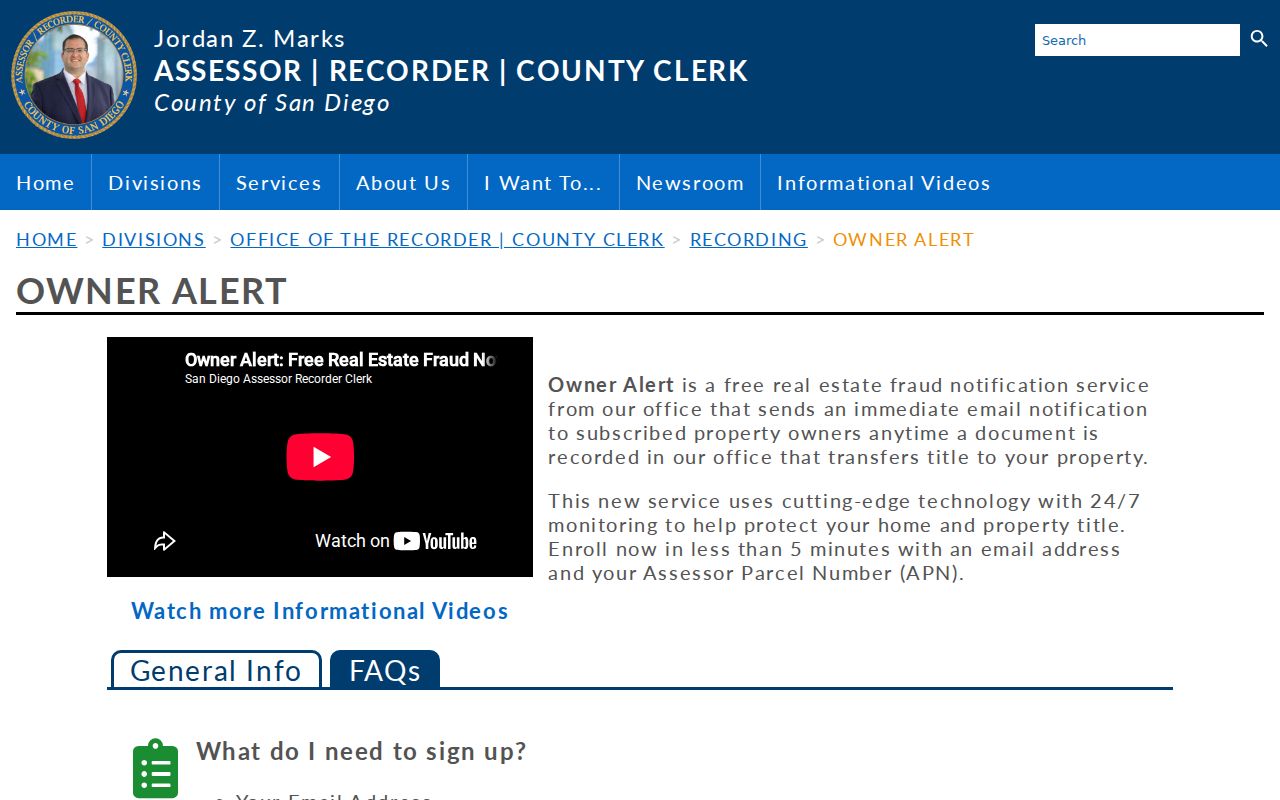
Owner Alert does not replace a title search or block a filing. It gives enrolled owners notice that can prompt a quick review of a new recorded transfer document.
Vista Records Since Statehood
San Diego County’s record system predates Vista by more than a century. The County Clerk and Assessor were established in 1849, and the Recorder followed in 1850. Early staff copied instrument text into bound volumes and kept separate party indexes. In 1921, California authorized a combined General Index across document types. The Assessor, Clerk, and Recorder functions later converged, with the County Clerk and Recorder merger implemented in 1991.
Vista incorporated on January 28, 1963. Its later cityhood explains the split visible today: municipal documents begin with city government, but older land, court, voter, and vital trails usually belong to San Diego County or California. Early county instruments can even concern land now in Imperial, Riverside, or San Bernardino Counties because historic county boundaries were larger.
The record format changed, but the access chain remains useful. Modern web indexes point to a filing. Kiosks, bound indexes, microfilm, mailed copies, and archive staff supply what the portal leaves out. Keeping those channels distinct is the safest way to read a Vista record in its full context.